The Future of Paving Quality Isn't Experience. It's Data.
A Gut Feeling Isn't a Quality Plan
For most of paving's history, quality came down to experience. A veteran operator could feel when the mat was right. A skilled foreman could read a paver and know when something was off before the gauge even confirmed it. That intuition was, and still is, genuinely valuable.
But intuition was never a quality plan. It was a workaround for not having one.
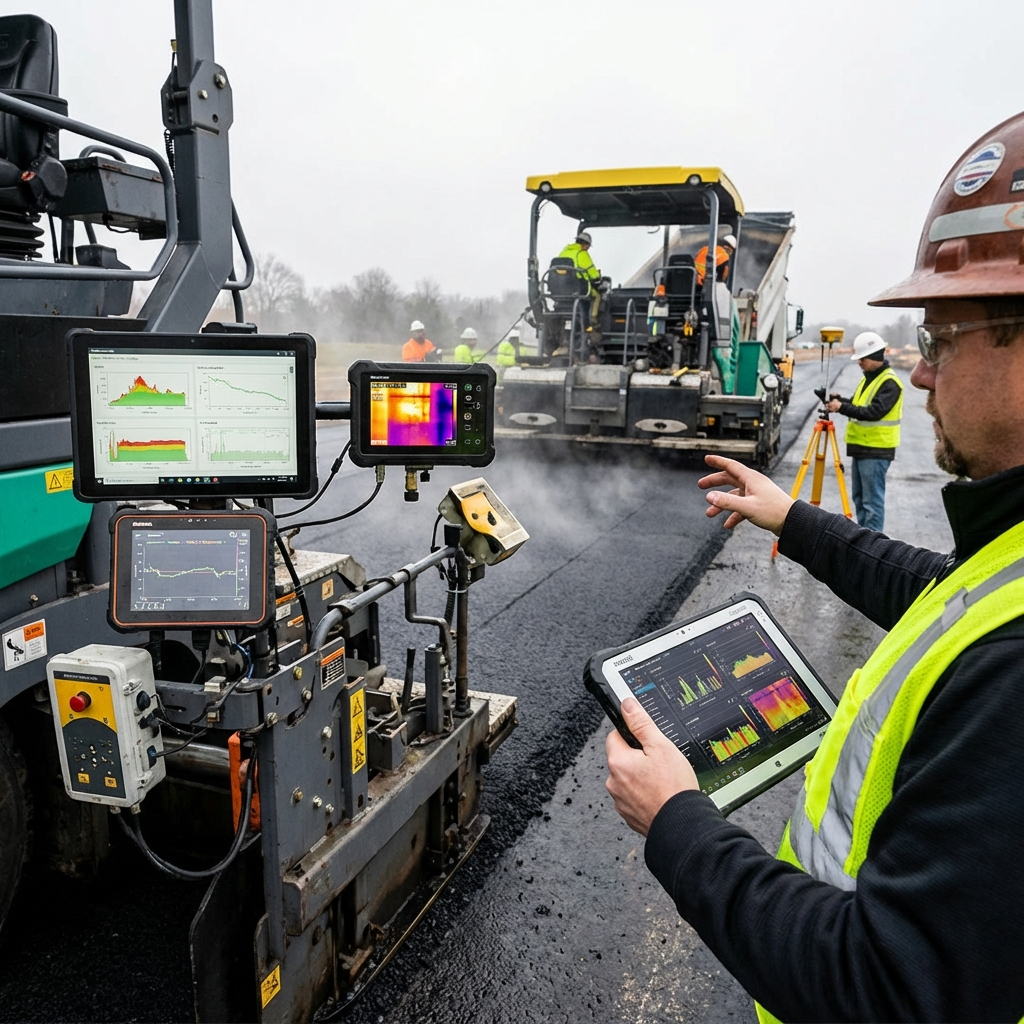
Today we have tools that can tell us what's happening across the entire mat with a level of detail no human eye can match. Intelligent compaction, density gauges, and performance monitoring tools have changed what's possible in quality control. And the contractors embracing that shift aren't just producing better work. They're protecting their margins in ways that weren't available five years ago.
What Intelligent Compaction Actually Is
There's a lot of buzz around intelligent compaction, and like most buzz, it sometimes obscures more than it clarifies.
At its core, intelligent compaction equips rollers with GPS, accelerometers, and data systems that track compaction effort continuously across every pass. Instead of a handful of spot measurements, you get coverage data across the entire compacted area. Instead of finding out during QA that you missed a zone, you find out while you can still do something about it.
That shift from reactive to proactive is the whole point.
The best QC processes I've seen don't wait for QA results to tell them how they did. They've already captured enough data during the work itself to know the answer before the agency inspector shows up. Intelligent compaction is a big part of how that's becoming possible at scale.
The Coverage Problem with Traditional QC
Here's a number worth sitting with: traditional destructive coring, the longtime gold standard for quality verification, typically samples less than 1% of the finished mat. Often it's closer to 0.5%.
You're being judged and paid based on a fraction of a fraction of your actual work. That's not quality assurance. That's a sampling lottery.
Intelligent compaction and modern density tools change that equation. Depending on the approach, you can go from 1% coverage to 10%, 50%, even close to 100% of the mat. That's not just a better data set. It's a fundamentally different relationship with quality. You're not hoping a core happens to land on your best work. You're proving the entire job was done right.
Data Without Process Is Just Noise
I want to be straight about something: technology doesn't fix a bad process. It amplifies it.
Contractors who add intelligent compaction to a chaotic, inconsistent operation don't suddenly produce great results. They produce better data about their chaotic, inconsistent operation. The technology reveals problems. It doesn't solve them on its own.
The contractors who get the most out of data-driven quality tools are the ones who've already done the work to standardize their process. They know what good looks like. They've defined it clearly. And they use the data to confirm they're hitting it, and to catch it fast when they're not.
Data is only as valuable as the decisions it drives. If your team isn't set up to act on what the numbers are telling you, in the moment when it matters, you're not getting much of a return.
What This Means for Contractors Right Now
The shift toward data-driven quality isn't coming. It's already here. Agency requirements are getting more stringent. Documentation expectations keep rising. Customers want proof, not just a finished surface.
Contractors who build their QC process around real data, density, temperature, compaction coverage, will be better positioned to meet those expectations, earn performance bonuses, and defend their work when disputes come up.
Those who wait will find themselves playing catch-up in an environment that isn't getting more forgiving.
The good news is you don't need a complete overhaul to start. You need a commitment to collecting better data, using it consistently, and treating it as part of the daily workflow rather than an afterthought.
Final Thoughts
The era of running on gut feel and hoping the core lands somewhere good is winding down. Not because experience stopped mattering, it still matters enormously, but because the industry now has tools that can validate what great crews have always known: that quality gets built into the mat, one pass at a time.
Data-driven quality isn't the future of paving. For the contractors paying attention, it's already the present.
At Pavewise, we're building tools that help contractors turn field data into better decisions. Follow along or reach out to learn more.